
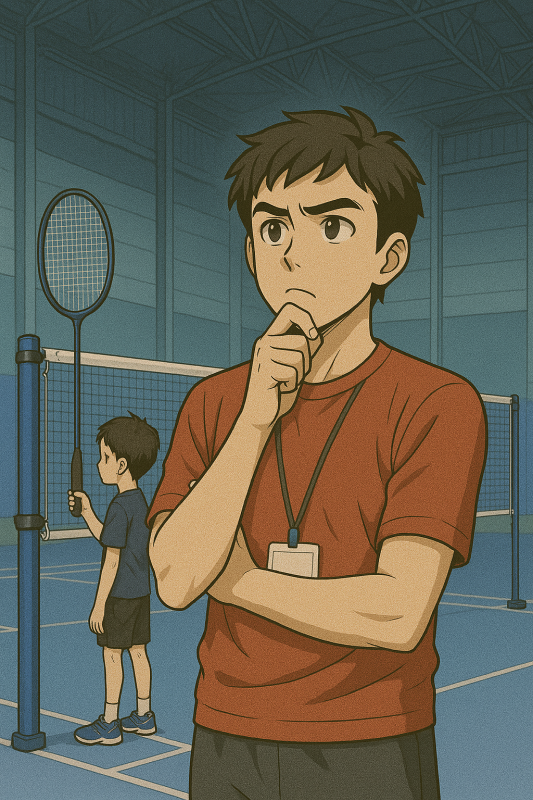
Some children reinvent the game in their own way, and most of the time the version they create is wrong. They try to avoid physical effort to win. Sometimes they succeed, most of the time they do not. And because they sometimes get away with it, they do not learn from it. Just carry on with the same thing.
They focus on their own ideas instead of developing efficient movement and clean technique. With this mindset they will not grow into competitors, so if any of them want to become one, and some of them really do, then something has to change.
A Real Life Example
Imagine a child with a strong high serve. Good swing, clean contact, long and high trajectory. But that is all they have. No overhead technique, no balance, no movement base, no footwork. Nothing else. Just the serve.
While many other children are struggling with coordination, this one looks different because of that single skill. No one at their level can return it, so they look like a strong player. But put them against a coach who can easily return a high serve, and the illusion collapses immediately.
These are the children who say, “Why try if I can win like this?” And in their world, they are right. So the coach must find a solution.
The Challenge for the Coach
You know you need to spend time to develop them, but right now they are at a stage where they do not care, and will not learn. They want to prove that their shortcut works. They avoid effort, avoid the feeling of being wrong, avoid looking silly. They care more about their friends than the sport.
And they will never admit any of this even if you ask, which is part of the comedy of coaching.
But here is the important part. These are the same children who keep coming back every week. They do the activities, they somehow follow instructions, with low attention taking to someone, but they are present.
And presence is the currency of development.
The Coach’s Mental Strategy
You need a mindset that keeps you positive, keeps you patient, and prevents burnout. A strategy that moves them gently towards wanting more, without pressure, without shame.
One day, the child will come to you with a cheeky smile and ask, “Do I have to do that?” or “Will I get to try that?” And this is where the magic happens. You smile back and say something light and playful, such as:
- “Based on what I see from you every week, that might be too much for now.”
- “No, no, you are the funny one, stay with the easy stuff.”
- “You do not need that, stick with something simple at your level.”
And that is exactly the moment where demotivation flips into motivation. Not because you have pushed them, but because you have triggered the deepest instinct of youth. The desire to prove the older generation wrong.
The Win That is Shared
When you finally win them over, and they start working to prove you wrong, something bigger happens. One day they realise that in proving you wrong, everybody has won. These will be the children might understand the power of being a good educator at some point and start working as an educator themselves.
That is the beautiful part of coaching. The shortcuts they try, or the cheekiness, or the battles over effort should not really matter for you as a coach. Well, you are putting less effort in them, but not ignoring them. You’re following them to see when you can push the button of performance in them.
The moment when a child decides to grow is gold and cannot artificially made. The job is to help them get there without ever forcing it.