
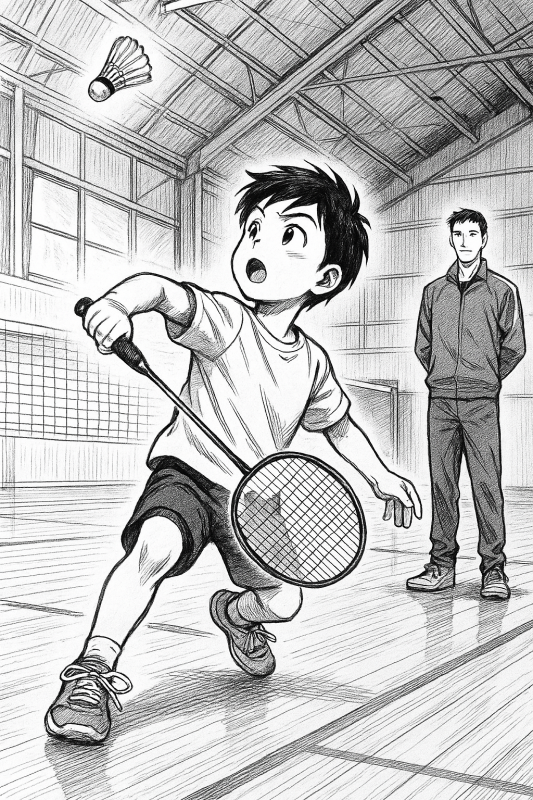
Parents want to see progress, which is a natural desire. They want their child to enjoy the sport, feel confident, and get better each week. Unfortunately badminton development does not follow a straight line and it points out many areas where the overall physical development of the child falls behind. Development is not fast, it is not simple, and it does not happen at the speed most people expect. That is what mastery means, to spend time with those things to become better, understand the nuances, recognise the differences, and make it happen.
1. Children Need Time
A world class badminton shot can take years to build. Even a clean, simple movement can take months before it looks natural. When a child learns a new skill, everything feels off. Their balance, rhythm, coordination, strength, timing. All of it needs time to connect.
To the parent’s eye, the child may look “bad at it.” To the coach’s eye, the child may be improving in ten small ways that no one else sees. Both views are real, but only one view is projecting the long journey.
2. Progress looks Invisible for a Long Time
Some children cannot perform a standard shot for months. That is not a sign of failure. It is a stage of development.
The coach sees:
- a slightly better grip
- a cleaner contact point
- a more stable landing
- a quicker reaction
- a better understanding of movement
Parents often do not notice these early steps, but these steps matter more than any “quick improvement.”
3. Each Child’s Motivation Is Different
Sometimes the child wants to be there, but the parent is disappointed with the speed of progress.
Sometimes the parent is more motivated than the child, so the development could not be slower.
All of these situations can create pressure. Pressure slows learning. A child learns best when they feel no pressure towards learning, are supported by their parents, and are allowed to grow at their own pace. They already experience pressured learning at school. They want to get away from it, not walk into another form of pressure. They want to release stress, not add more to it.
Some children come to the session only because they want to play. That is usually a sign that they would be happier hiring a court with their parents or friends, where they can play freely without instructions.
They are not looking for mastery, they are looking for simple enjoyment, and that is perfectly fine. They do not need the technical work or the “boring stuff,” and they should not feel forced into it.
Sometimes I have to point this out to parents early. Sometimes it becomes clear only after six months. Children naturally change interests, and there is nothing wrong with that.
Friendship can also influence why they attend, which is understandable, but it can make the training structure and focus of the group unstable or even toxic if the motivation is not aligned.
This is why I prefer to have a few gentle conversations with the child first. Maybe they are just testing boundaries, or maybe they genuinely struggle with being in the session. Understanding their motivation is always the first step.
4. When You Are the Weakest Player On the Session
Children often look around and think they are the worst in the group. They feel embarrassed or alone. When that happens, I work closely with them, and I play the game with them. Playing is the fastest path to building confidence, rhythm, balance, and decision making at the same time.
The goal is not to become “the best in the room.” The goal is to become better than yesterday.
5. Mastery Is Built Through Repetition, Not Talent
Mastery is not magic. It is not instant. It is built slowly, through:
- repeating movements
- correcting mistakes
- growing physical strength
- developing timing
- building confidence through experience
When all these pieces come together over time, the shot becomes automatic. That is mastery. But it does not happen quickly. The little ones have to make that decision, and when they do, everything starts to work so quickly and naturally that everyone thinks some magic happened. But no, there is no magic.
That is where dedication meets talent, and through hard work, consistent movements and quality shots begin to appear in a way no one else understands. Only the coach does. For the coach, it is a refreshing moment, because he is probably the only one who remains unbiased about mastery. He knows how rare it is.
6. Wrap up
Mastering a badminton shot is a long process. It requires patience, repetition, physical development, and emotional safety. Children improve slowly, in tiny invisible steps that only trained eyes notice. They learn best when they feel no pressure, when they are supported consistently, and when they are allowed to grow at their own pace.
Parents can help by understanding that development is not a straight line. It is normal for a child to look unbalanced, unsure, or “bad at it” for months while their body learns rhythm, timing, and coordination. It is normal for motivation to rise and fall. It is normal for interests to shift. None of this means failure.
If your child learns a shot slowly, that is not a problem. That is the path. Mastery grows from patience, trust, repetition, and the child’s own decision to engage with the skill. When all these pieces connect, the movement becomes natural and effortless, and suddenly everybody sees the improvement.
But it was never magic. It was built quietly, through hard work. Support your child. Trust the journey. Celebrate effort, not speed. Mastery will come when the child is ready, and when they choose to meet the sport with curiosity, discipline, and joy.