
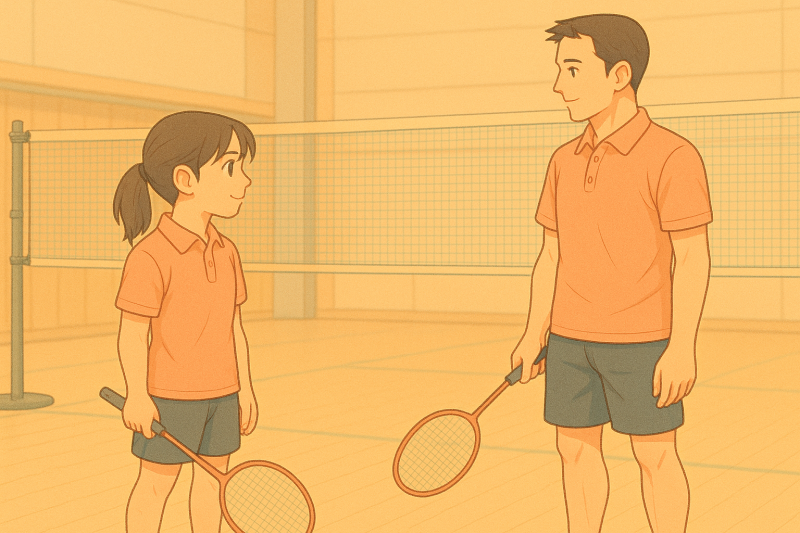
There is a big debate around whether children should play badminton against adults. Some say it is wrong, some say it is part of development. The truth is simple. Adult competitions are built for adults, children’s competitions are built for children. The gap between the two is not small, it is massive.
Why it becomes unnecessary and unfair
Adults do not step on a court to hold back. They want to play freely, with their normal strength, speed and instinct. That is natural. But for a child under 14, especially for girls, this creates an imbalance that is impossible to ignore.
A strong adult, even an average adult player, carries more intensity, more weight transfer, more forearm strength, more acceleration and more match experience than any junior. The child will feel overwhelmed.
Even if they have good technique, even if they move well, the adult game hits them in a way they are not physically ready for.
This is not about talent. This is biology.
If a child wants to enter adult competition
If a child chooses to enter, they must understand what is waiting for them. Adults will not soften their game. They will not take 40 percent off their smash to be polite. They compete as adults.
When a junior steps into that environment, they are stepping into adult reality. They will meet power, speed, racket acceleration, mental pressure and tactical discipline they have never seen before. This is not wrong, but it is not gentle.
What is the benefit for children?
There is only one real benefit. It shows them the truth.
Children see that the level they dream about does not come from being fast in training, or hitting a clean shot in a quiet hall. It comes from years of pressure, years of losing, years of physical growth, years of refining technique until it survives intensity.
And this is the key message:
Skill is not how good you look when nobody pressures you. Skill is technique that stays alive under stress.
Many juniors trust ineffective techniques because they work against other juniors. They play cross net shots with lazy preparation, they hit lifts with loose wrists, they block without balance, but because they can beat children with it, they believe it works.
Put that same technique under an adult’s pace and it collapses.
Playing adults exposes reality. You cannot hide behind junior habits. If it is not solid, it breaks. If it is solid, it thrives.
Why this experience matters
For some children this is overwhelming. For others it is motivating. The ones who want to be good need to see this gap. They need to understand that talent is not enough. They need to learn that technical quality must survive pressure, and that intensity is something you grow into, not something you can pretend to have.
Adult play shows them:
- where they stand
- how far the path really is
- why consistency beats tricks
- why strength matters
- why movement must be efficient
- why technique must be honest, not stylish
Some children need this reality check to fuel their long term development.
But this experience must be chosen, not forced
A junior should never be pushed into adult competition. If they ask for it, if they want to test themselves, then let them experience it. But they must enter with open eyes, not with false hope.
Adult badminton is a different world. It takes years, not months, to reach it. Many lost fights, not a few. Real skill grows only under real pressure.
Final message
Adults versus children is not about fairness, it is about purpose. Adult competitions exist for adults. If juniors want to step in, they step into a world where nobody will hold back, and that is exactly the point.
It is not meant to be easy. It is meant to be real. And real badminton is the best teacher they will ever meet.